









Joint Health
The Complete Guide
to Joint Health
Evidence-based insights to help you understand, protect, and support your pet's mobility — at every stage of life.
Why joint health can't wait until the limping starts
Joint degradation is a slow process. By the time stiffness or limping becomes visible, cartilage loss is already significant — and largely irreversible.
This guide explains how joints deteriorate, what accelerates the process, and what proactive supplementation can actually do to slow it down.
Glucosamine and chondroitin supplementation has demonstrated statistically significant improvements in pain scores and mobility in dogs with osteoarthritis.
What to do
Three things you can do starting today
Start joint support before symptoms appear
Large breeds, active dogs, and seniors benefit most from early supplementation. Prevention is dramatically more effective than trying to reverse established damage.
Maintain a healthy weight
Every pound of excess weight adds three to five pounds of force on joints. Weight management is one of the highest-impact interventions for joint longevity.
Minimize unnecessaChoose low-impact, consistent exercisery antibiotics
Controlled walks, swimming, and gradual conditioning keep joints mobile without overloading them. Avoid intense bursts followed by long rest periods.
The science
Cartilage has no blood supply — it can't heal itself
Unlike most tissue, cartilage relies entirely on nutrient diffusion through synovial fluid. Once degraded, it cannot regenerate — making prevention the only real strategy.
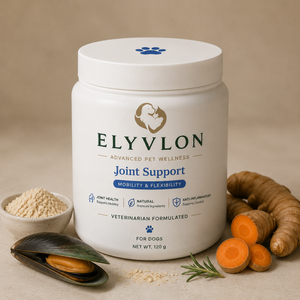
Our joint formulas deliver glucosamine, chondroitin, and MSM at clinically supported doses — not cosmetic amounts added to justify a label claim.
Clinically StudiedSigns to watch
Signs your pet's joints may need support
If you notice two or more of these signs persisting, it may be time to act.
Stiffness after rest
Difficulty rising from lying down, especially in the morning, is a hallmark early sign.
Reluctance to jump or climb stairs
Avoiding movements that previously caused no hesitation indicates joint discomfort.
Visible limping or favoring a leg
Consistent gait asymmetry points to localized joint pain or inflammation.
Reduced activity or play
A dog that used to run eagerly becoming sedentary may be managing chronic discomfort.
Audible clicking or popping joints
Crepitus during movement can indicate cartilage thinning or joint laxity.
Licking or chewing at a joint
Focused attention on a specific area often signals localized pain underneath.
Ready to act?
Science-backed joint support, made simple.
Clinically studied, vet-reviewed, and dosed to actually protect — not just appear on the label.